Slow down.
Go farther.

One base. Go as far as you want.

A different way to travel Japan, with Tsuruga as your base.

TSURUGAyour baseFUKUIabout 20 minKANAZAWAunder 1 hrTOYAMAabout 80 minKYOTOabout 55 minOSAKAabout 85 minNAGOYAabout 100 minTOKYOabout 3¼ hrs TSURUGAyour baseFUKUIabout 20 minKANAZAWAunder 1 hrTOYAMAabout 80 minKYOTOabout 55 minOSAKAabout 85 minNAGOYAabout 100 minTOKYOabout 3¼ hrs

Most trips through Japan are built around moving.

Tokyo. Kanazawa. Kyoto. Osaka.

Every second or third morning, you pack. You check out. You take everything you brought with you to the station, and you find somewhere to leave the bag until the next room is ready. Then you check in, unpack, and begin again.

Nobody counts this as travel.

It is the tax you pay on travel.

There is another way.

Leave your suitcase in one place.

That's it. That's the whole idea.

Go for the day. Go for two. Come back when you want.

Travel farther. Move less.

At first what you gain is just time. Nothing to pack in the morning, nothing to check out of, nothing to check into at the other end.

Then something less obvious.

When you book four hotels in four cities, you have decided the trip before you have taken it. Wednesday is Kyoto because your suitcase will be in Kyoto on Wednesday. Rain, a cold, a place you wanted one more day of — none of it changes anything.

You end up following your luggage around Japan.

Leave the bag in one place and that stops.

Rain tomorrow? Go somewhere else. Liked Kyoto? Go back. Nobody says you see each city once. Wake up tired? Stay close. A train leaving in twenty minutes, going somewhere you like the sound of? Take it.

The itinerary stops running the trip.

This only works from the right place.

It has to sit between places worth going, with connections good enough that you can head in different directions without moving your base.

Tsuruga is built for it.

Tsuruga has always lived between places.

Start with what it is now.

The Hokuriku Shinkansen runs west from Tokyo through Nagano, Toyama and Kanazawa, and then it stops. Tsuruga is the end of the line.

West of here you change onto the Thunderbird, which runs down to Kyoto and Osaka. And something else starts here: the Special Rapid, the ordinary fast service of the Kansai region. Its northern terminus is Tsuruga. Trains to Kyoto, Osaka, Kobe and Himeji begin on this platform — no transfer, no reservation, no express supplement.

Kanazawa to the north. Kyoto to the south. Both are less than an hour away.

That looks like a railway story. It isn't.

Look at the land instead.

Wakasa Bay cuts deep into the coast here, deep enough and sheltered enough that boats have been putting in for as long as there are records of it. Behind the town, mountains. In front, the Sea of Japan, and past that the continent.

A working harbour with mountains behind it is a place where things have to change hands. Cargo off boats and onto roads. People off roads and onto boats. Kelp came down from the north by sea and went inland from here. All of this was true centuries before anyone laid a rail.

The railway did not make Tsuruga a junction.
It found one.

Which is how, for a few decades, this became the edge of Japan.

From the early 1910s you could buy a single ticket in Tokyo and travel to Paris on it. The train part ended at Tsuruga. A ship took you across to Vladivostok, and the Trans-Siberian did the rest.

TOKYOTSURUGAVLADIVOSTOKPARIS

One line, and this town was the point on it where you left the country.

A place does not become the edge of a country's railway network by accident.

The ships are gone. The through-trains to Europe are gone.

The geography isn't.

The bay is still deep. The mountains are still behind the town. The corridor between the Sea of Japan and Kansai still runs through this gap — and in 2024, a new Shinkansen line came west along it and stopped here.

Being between places is still part of what Tsuruga is.

Which makes it useful as a base. But usefulness is not the reason to stay.
Can you actually do this?

Last train back
Kyoto
about 55 min
21:21
Kanazawa
under 1 hr
22:34
Osaka
about 85 min
20:54
Fukui
about 20 min
23:10

None of these needs a change of train.

Regular daily services only. Excludes seasonal and limited-date services. Timetables verified September 2026.

All destinations, fares and slower routes

The first night, you look for somewhere to eat.

You check the map. You look at menus. You wonder which places are still open.

The second night, you already know which way to turn.

By the third, you know which light will still be on when you get back.

Things begin to repeat.

The confectioner in the morning.

The kombu shop.

The tea shop.

The bedding store pulling its shutter down as you pass in the evening.

None of this is being shown to you. The shops open when they open and close when they close.

You are simply passing the same places again.

And they are becoming familiar.

On the fourth morning, you pass the manjū shop before it opens. The lights are already on.

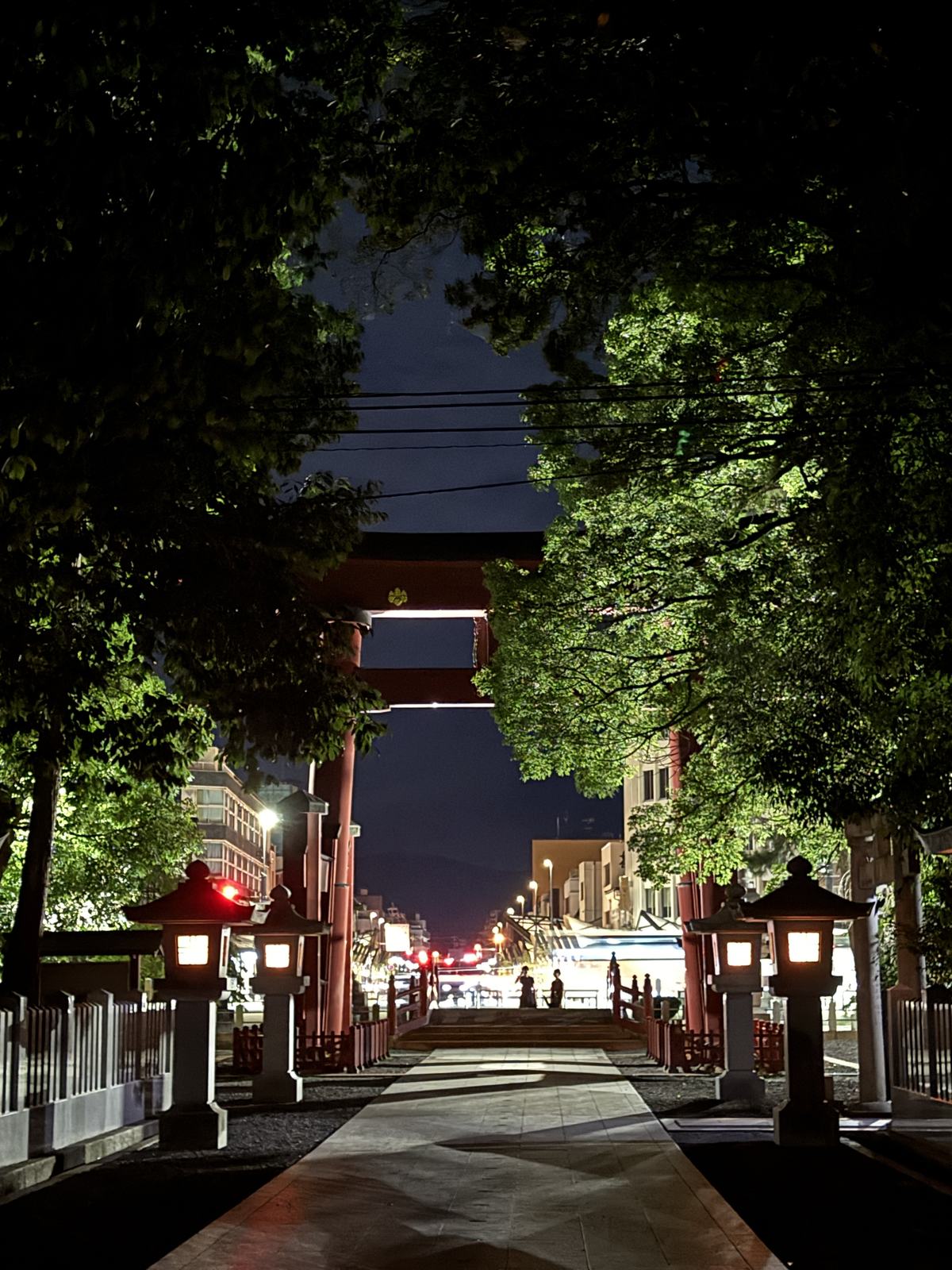
That evening, you come back after dark. The shrine gate is closed.

You know the rest of the way without looking at your phone.

And somewhere along the way, you start saying back.

Back to Tsuruga. Not on to Tsuruga. Back.

The approach to Kehi Jingu at night, looking out toward the town

A few days earlier, it was the way to where you were staying.

Now it feels like the way home.

That is what staying changes.

Seven days from here.

Day 1
Arrive. Don't go anywhere.
Day 2
Go. Kyoto.
Day 3
Stay close.
Day 4
Go. Kanazawa.
Day 5
Choose. Tokyo.

07:27 Tsuruga  →  10:37 Tokyo

BACK TONIGHT

20:00 Tokyo

23:16 Tsuruga

STAY

Sleep in Tokyo.

Take a small bag.

Come back tomorrow. Or later.

Day 6
Day 7

You don't have to decide this when you book your base.